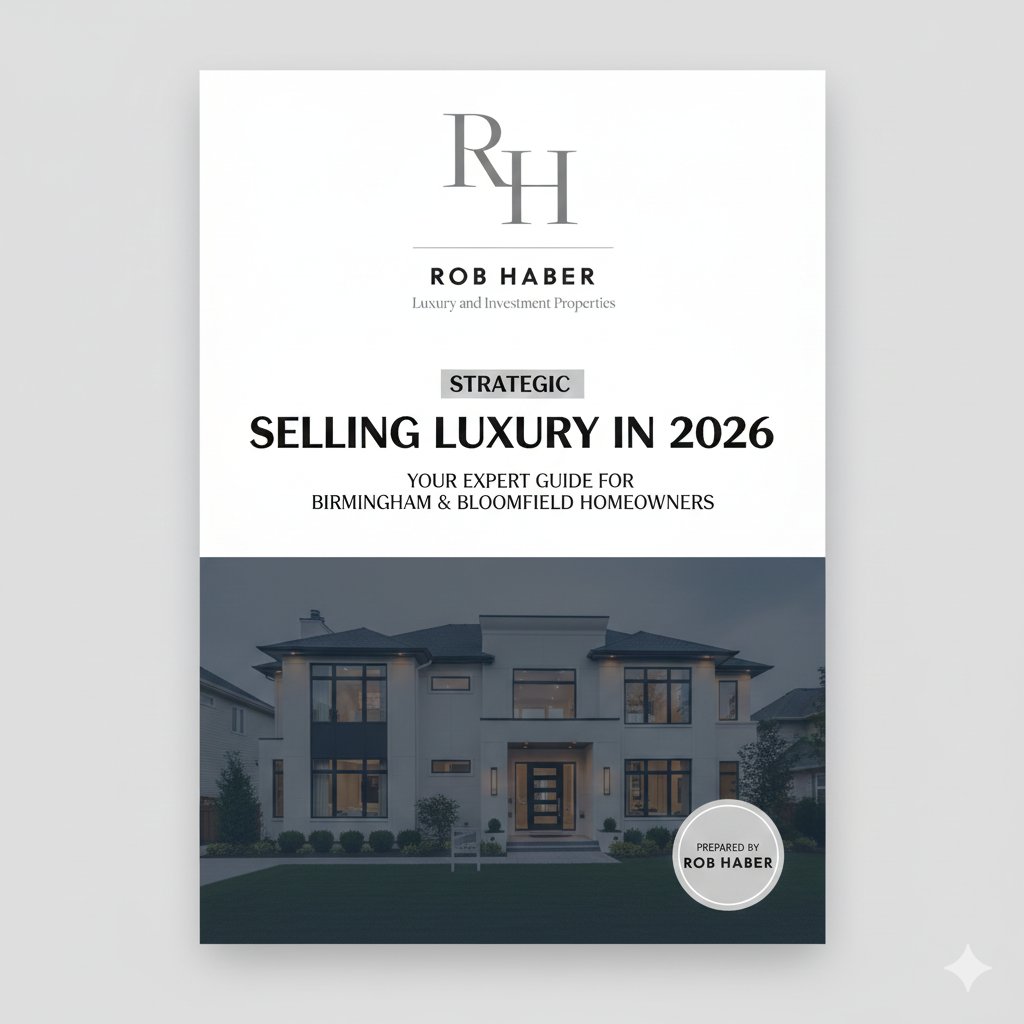
Selling Your Luxury Home: The 2026 Strategic Guide
Selling a luxury home in Birmingham or Bloomfield Hills can be very different from selling in the rest of Michigan. Every local market appeals to a unique set of buyers. Homeowners are often automotive and tech leaders, healthcare experts, sports and media celebrities, private equity partners, and innovative entrepreneurs. They appreciate quality construction and seek out sophisticated marketing when selling. Sales over $1 million in these communities require unique positioning and often total discretion. It's also important to understand what motivates high-net-worth buyers. Here, neighbors are often colleagues, and social circles mix with professional networks. This guide tackles the worries that often trouble sellers in Birmingham and Bloomfield Hills.
Will buyers judge my $400K custom kitchen as 'too personal' or outdated, even though it was cutting-edge 5 years ago?
Custom features represent value when positioned correctly, but they require careful presentation. The challenge is not the quality of your investment—it's demonstrating how those features solve problems for the next owner rather than create them.
High-end customization becomes an asset when you can articulate the "why" behind each decision. A $400,000 kitchen isn't just about Italian marble and professional-grade appliances. It's about the infrastructure: the dedicated electrical capacity for multiple high-BTU ranges, the engineered ventilation system, and the spatial flow that accommodates caterers during events. As a former licensed builder working in the Oakland County luxury market, I assess these features through a marketing lens—identifying the upgrades, special modifications, and systems that buyers and appraisers often miss.
The key is reframing personal choices as functional advantages. Your wine cellar isn't a hobby room; it's a climate-controlled storage solution with backup power and proper racking systems. Your home theater includes acoustical engineering and electrical rough-in that would cost six figures to replicate. When I present and describe these spaces, I emphasize the details of what was installed, why it adds value, and how it differentiates the property from new construction using less desirable alternatives.
Buyers don't always "just see" the value. Properties that command premiums are those where every custom element is explicitly connected, through strategic marketing to lifestyle benefits, structural superiority, or cost-to-replicate arguments.
How do I sell discreetly without broadcasting to my neighbors, clients, or business partners that I am leaving?
Discretion and market exposure are not mutually exclusive when you employ a tiered selling strategy. The solution is controlled access: showing your property only to pre-qualified, serious buyers while maintaining privacy from your immediate circles.
The traditional MLS listing with a yard sign is incompatible with executive-level privacy. Instead, sophisticated sellers in Birmingham and Bloomfield Hills use a combination of pocket listings, qualified buyer networks, and delayed public exposure. I maintain relationships with wealth managers, relocation specialists, and luxury brokers locally and nationally who represent pre-vetted buyers actively seeking Oakland County properties.
We can require buyers to provide proof of funds, demonstrate purchase intent, and/or sign confidentiality agreements before receiving property details. When pocket-listed, your property circulates exclusively within a closed network of realtors. No public marketing, social media or open houses. You control who knows you're selling and when.
Photography and showing protocols protect your identity. Virtual staging can depersonalize spaces. We can remove family photos, business awards, and identifying documents during professional photography. Showings occur by appointment only, with 24-hour notice, and never during hours when your vehicles are visible or when neighbors might observe unusual activity. If we identify a buyer during this phase, the transaction concludes without the general public's knowledge.
The reality is that many Birmingham and Bloomfield Hills luxury transactions close quietly. Buyers value discretion as much as sellers do. Engineering the entire process to minimize disruption while maximizing legitimate buyer access requires infrastructure: secure showing systems, NDA protocols, and buyer qualification standards that protect your privacy without sacrificing competitive positioning.
How do I maintain my family's routine and privacy and still allow showings while I work from home and have school-aged children?
Showing logistics requires planning, not surrender. You can control the process while maintaining reasonable buyer access through structured showing windows and professional preparation systems.
The anxiety around showings stems from imagining chaos: strangers in your home daily, disrupted work calls, children's routines upended, and personal items exposed. The reality is more manageable in the local market. Most luxury buyers schedule showings 24 to 48 hours in advance. They tour during predictable windows—typically weekday afternoons and weekend mornings. You can establish blackout periods for work commitments, family dinners, or school activities.
The key is systematization. I help sellers set up showing-ready protocols. This includes:
- Designated spots for personal items, such as medications, financial documents, and valuables.
- Plans for managing pets.
- Quick-reset checklists.
- Designated showing time windows.
The alternative—refusing showings or imposing severe restrictions—extends your market time and reduces your negotiating leverage. Buyers may interpret showing difficulty as seller desperation or property problems. It may be better to embrace temporary inconvenience as a strategic cost of transaction velocity.
Will my home be penalized because there aren't any true comparables for a custom-built property like mine?
Custom properties in Birmingham and Bloomfield require narrative valuation, not just comparative analysis. Your home's value comes from articulating replacement cost, architectural significance, and site-specific advantages that standard comparables cannot capture.
Appraisers and buyers find it hard to evaluate custom homes. This is because MLS data favors "typical" listings instead of unique properties. When your home features hand-cut stone from a specific quarry, custom millwork, or structural engineering for open-concept spaces, the $1.2 million colonial three streets over becomes irrelevant as a comparable despite similar square footage. In neighborhoods like Quarton Lake or Bloomfield Village, off-market comps are critical—many comparable luxury transactions never appear in public MLS data. This is where my background as a former licensed builder and experienced Luxury Marketing Specialist, working in Oakland County, becomes essential.
I document your home's construction story. What were the architectural challenges of your lot? What engineering solutions did your builder employ? What materials were specified and why? Custom homes often involve structural decisions that add tens of thousands in cost but appear invisible to untrained observers—steel beam installations for open floor plans, foundation engineering for difficult topography, and upgraded mechanical systems for whole-home systems integration.
We create a technical dossier: original architectural plans, material invoices, engineering specifications, permit history, and contractor credentials. When an appraiser sees documentation that your home's geothermal system cost $85,000 to install, that your stone was imported from a specific Italian region, or that your timber framing required specialized craftsmen, these details establish value parameters beyond square-foot comparisons.
Market positioning matters. Custom homes speak to a particular type of buyer—clients who value quality, individuality, and the kind of craftsmanship you can't easily replicate. Our marketing highlights that uniqueness and reaches buyers who understand they're investing in something truly one-of-a-kind, not just another house on the market.
The properties that command premiums are those where every unique element is explicitly presented, documented, and positioned as an advantage rather than an anomaly.
Should I make significant pre-sale updates, and will I recoup it in this market?
Strategic updates target buyer objections, not your personal preferences. Focus capital on repairs, modernization of dated primary systems, and a neutral refresh of high-impact spaces. Avoid discretionary improvements that reflect your taste rather than market standards.
The ROI question requires market-specific analysis. In Birmingham and Bloomfield Hills' luxury markets, certain updates command a return while others represent dead capital. The key distinction is between addressing deficiencies and pursuing perfection.
Deficiencies needing attention include:
- Deferred maintenance includes roof repairs, HVAC updates, and failing hardscape.
- Outdated primary bathrooms or kitchens showing neglect.
- Cosmetic issues that hurt your home's main strengths.
Updates that typically return value: fresh interior paint in contemporary neutrals, refinished or replaced flooring in primary living areas, modernized lighting fixtures, an updated master bathroom (if currently dated), and landscaping refreshes that enhance curb appeal. These improvements can influence the sale price while significantly reducing days on the market.
Updates that rarely return full value: luxury kitchen remodels when your current kitchen is functional and less than 15 years old; bathroom additions; finished basement upgrades; pool installations; and extensive landscaping projects. These improvements reflect personal preferences and may not align with buyer priorities.
As a former builder, I assess your home's condition through a marketing lens. Sometimes, the optimal strategy is to acknowledge age-related wear and price accordingly rather than invest capital you will not recover. Every dollar spent should be evaluated against its impact on sale price and transaction velocity.
How do we find the Perfect Buyer?
Market timing requires balancing current conditions against future uncertainty. Waiting for perfect conditions often costs more than transacting in imperfect ones.
The "perfect buyer" is typically defined as someone who loves your exact customization choices, does not negotiate aggressively, closes quickly, and waives contingencies. This buyer exists but appears unpredictably. The cost of waiting is quantifiable: monthly carrying costs, potential market deterioration, and other opportunity costs of capital locked in your current property.
In Birmingham and Bloomfield Hills' luxury markets, inventory levels fluctuate seasonally and economically. Spring typically brings an increase in listings as families' time shifts to school calendars. If mortgage rates decline, more sellers will list simultaneously, anticipating improved buyer demand. This creates competition that did not exist when inventory was constrained.
The strategic question is: do current market conditions favor your property's specific characteristics? If you have a move-in-ready home in a prime Birmingham or Bloomfield Hills location during a low-inventory period, your leverage is high. Waiting for rates to drop may flood the market with competitive listings, diluting your advantage.
Conversely, suppose your home requires updates or features with controversial elements (extreme customization, challenging lot, dated finishes). In that case, a higher-inventory environment could help by attracting more buyer traffic and offering more options for different buyer types to find their match.
I monitor several key data points: current luxury inventory levels in Birmingham and Bloomfield Hills, absorption rates (how fast homes sell), new listing activity, and price-per-square-foot trends in Oakland County. When absorption rates are strong and inventory is low, sellers have pricing power. When new listings are accelerating and days on market are extending, buyers gain leverage.
I provide market intelligence and scenario analysis. What happens if you list now versus waiting 90 days? What are the carrying costs? What is the probability of improved conditions? This allows for rational decision-making rather than emotional speculation.
The perfect buyer appears when you position your property correctly in current market conditions, not when you wait for ideal external circumstances. Strategic positioning beats market timing.
Schedule Your Private Valuation
Selling a luxury home in Birmingham or Bloomfield Hills means knowing about construction quality, local market trends in Oakland County, and the mindset of high-net-worth buyers. In these areas, a strong professional reputation plays a key role in real estate choices. As a Keller Williams Certified Luxury Home Marketing Specialist and former licensed builder with extensive experience in Birmingham and Bloomfield Hills, I provide valuation analysis that accounts for structural integrity, architectural significance, and market positioning strategies that typical agents miss.
A private valuation includes:
- A thorough property assessment.
- A custom analysis of comparable properties, even off-market ones.
- A report on current market conditions in the Birmingham and Bloomfield Hills luxury segments.
- A strategic pricing suggestion.
- A tailored marketing plan that respects your privacy needs.
Please feel free to contact me to schedule a confidential consultation. We will tour your property, discuss your timeline and concerns, and develop a marketing strategy that protects your interests while maximizing transaction value.
Rob Haber, a Keller Williams Certified Luxury Home Marketing Specialist, Former Licensed Builder, Birmingham & Bloomfield Hills Luxury Real Estate.